|
|||||||||||||||||||
|
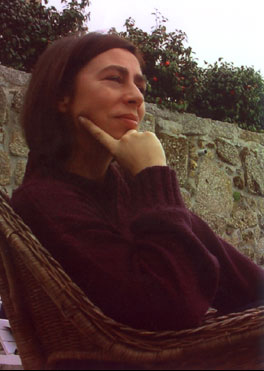
Paula Cruz
For a life time Paula Cruz has developed her creativity and self-awareness, breaking into the world of art with determination. Healing and Divine Energy are also an integral part of her subtle Universe. "The soul which seeks spiritual consciousness through release from fear and pain." The loving intensity with the Divine, a simple synapse of ineffable sensations which, in the end, translate themselves into the faculty of understanding. "My experience of painting is visceral,
The explanation of her creation, her intense psychic life, a neurology of art, conquors the power to express emotion in each one of us.
EMOTIONS |
|||||||||||||||||||
|
"My experience of painting is visceral. I evoke emotion, sensed at every moment.
SPOKEN THEME - SPIRITUALITY
-Pain which is expelled in opposite directions.
The Soul which seeks spiritual consciousness trough release from fear and pain. Life Force which drives me. Suddenly an icy reality of molecules inhaled by the ecclesiastic womb I contract without contradicting myself.
I speculate between blood and love,
_______________________________________________________________________________________
___________________________________________________________________________________________________ Published Poetry Anthologies
|
|||||||||||||||||||
|
Professor Fernando Pernes
This materic painting is caught between a scream and a dream, between blood and the earth, arising from one knows not when, out of the depths of the world to a light-flooded vision in the night. At first glance, this is how this work by Paula Cruz will come across to us. The painting connects to her other verbal language and is transformed into an authentic handmade poem exposed in a fiery incandescence and opening into sultry dawns of a desired new day that crosses the eco of time, gushing out of visible space where the shapes crop up impetuously from the chaotic and later become simplified. These shapes are conceived by dense lines often diverging to energetic rectangular or spherical structures, yet always oozing with dripping ardour. Accordingly, one can say that the author's vast imagination is underpinned by the generic and the intuitive. There is a tremendous feminine sense of gut feel for her compositions, which are doubly penetrated by contrasts of intense chromatism with excruciating black. Subtle memories of lived, indivisible ecstasies of the flesh and spirit are expressed, whose complete union only a woman grasps through the joint experiences of lovable warmth and the splendour of childbirth. In other words: marrying the sensual with the spiritual to enrich the profound conscience of certain joys and pains that approximate the most intense vitalism inherent to the poor and noble human condition that is condemned after all to death. In fact, most of all this will be featured in Paula Cruz's best paintings, created on the tactile and the dense. Over and above this, they take on fleeting impulses aspiring to timelessness. This is consistent with what is desired in Rouault's mystique, according to whom the artistic would always approximate what is sacred, whereas for Matisse, the true sublimation of these rhythmic curves would transform them into the irradiance of Eros' luminosity. In this instance, both of these sensitive formulations are present throughout the work of the above-mentioned author, just as pleasure and suffering jointly reverberate there. It so happens that this is neither a painting nor a representation, nor a erudite speech for her, but rather a revelation of an indescribable psychic inwardness which does not aim at being aesthetic orthodoxies since it is something virtually fantasmatic. Using denotable expressiveness, given the certain fleetingness of highly blatant uniqueness along with sudden gloomy tones, vague profiles of faces of women are revealed every now and then, at times manifestly, while at others surreptitiously, who are interpreted as attractive souls at the resurrection of bodies yearning for past passions or crushed desires. Perhaps this is the reward for the puritanisms, which throughout the centuries, have always exited in hypocrisy masked as virtue. One may say, however, that in the painter's present, the here and now that is busy being revealed to us is the unveiling of the above, still existing conventions of the puritanical lie that is being projected. It is the supremacy of the truth, released from the womb for existential purity, which she resists. Irritated with herself, to the point of near uncontained brutalism, the surroundings of the indisputable reality of her painting along with baroquist and primitivist sounds, guide us to suggestions of a remote past. Yet it was certainly not by chance (remember Picasso and Klee) that the art of modernity recovered mythical archaic ancestry, which was obviously more imagined than actually lived. Moreover, under the circumstances at issue, this is revived by approximating the mothers of the world, who certainly continue to be more often raped than loved. Besides numbering in the millions, these anonymous sisters of the artist are frustratingly aware of the offences and manly sarcasms that so often respond to the feminine desire for passion. It is, however, like Paula, akin and venerated, to substantiate the heart of her culture and poetics released from the paintings carrying her name by sustaining the hope of living. For this reason, it is up to us to say, thanks Paula Cruz for being, knowing, thinking and sharing in this way with frank communicative clarity, announcing a tomorrow that will feasibly never again show up… Bernardo Pinto de Almeida Author and Art Critic Janeiro 2003 There is a moment during which those who believe that there flows within them a type of subterranean river, which by some is called talent and by others a curse, which neither can nor should any longer be ignored, and which requires of them an overflowing of their personal limits, that which is contained and is part of fear, superstition, excessive control, and which so often, maybe unjustly imposed on ourselves. Truly, that uncertain wisdom grows slowly in everyone. Truly, every river may find the sea to which it belongs, as its source no longer holds it, its banks boil with its rough passage. And there is always a moment in everyone's life which is tormented by that talent, during which he decides, against all odds, that be accomplished through the movement of consciousness and his very own growth. Neither shall I say that talent serves, of itself, for anything. The world would be better off without an overload of talent and that nature herself had economically undertaken the distribution. All talent which is uneducated (and the first sign of education lies precisely in its con-tainment until it is understood that it may no longer be contained) is a lost talent, treading water, a type of excrescence which so often is accomplished through the vanity of realising its own existence, or exul-ting in its own narcissism, fascinated by the mirroring, and condemned to drown itself. Talent, being a gift, is only deserving of its own effort, the fight to birth and project itself. This is not, therefore a defence through which each one releases his more brutish or more difficult aspect in the name of expression. Much less through what is described as self-expression, which comprises the right of all small and medium intellectuals or artists, or whatever, feeling it to be a gift from God. All those receiving a gift know, when of sound mind, that type of gift is only demonstrated through the giving, that is, placing it in service of something greater than the self, which transcends him, offering little, and oftimes stigmatising him through the very gift itself. a Paula Cruz has many talents. Poetry, painting and her children. That of knowing how learn from life, travelling, which is, and was to far-flung places both within and without. And above all, she understood that talent is not to be ignored and niether is it worth-while showing it to the world before making of it a means of greater, higher and more pre-cious communication. That it be completed by the gift of what it teaches. This her first exhibition, violent in its images, volcanic and uterine (that is, between outer, explosive and inner, implosive secrets) gives evidence of precisely that. Of an unknown measure, that talent has no self-confinement but multiplies itself when a strong consciousness inhabits it and transfigures it in something other, more powerful, more refined and more communicative. One does not seek in them the trace of that effort, that ascension to wisdom which comprises merely in no self-wonderment but rather in demanding that all that is given be turned to gift. And that all that was given be always reviewed in the mirror of another who humbly seeks himself. That is her greatest gift, and it is not a small one.
Paulo Cunha e Silva
The red and the black
Contemporary art sometimes seems a recognisable recipe, the use of a combination of solutions and easy, immediate effects, but of doubtful pertinence. I believe it possible to think of art through this idea of liberation of the inner self, the transformation of inner obscurity to outer, clear expression. It is obvious that this tendency, which may be called lyrical, expressionist, informal, subjective, has not appeared now through spontaneous generation. It has, naturally, its own geneology inscribed in History of Art. And, it had, in the twentieth century, those who transformed it into one of the great axes of art, Kandinsky, Pollock, or Tapies ou Kiefer. Art may thus be legitimately just a cry (like Munch), just a sensory experience. The author may only wish to show the colour of her soul, independantly of the search for safer solutions. With Paula Cruz' works we feel ourselves to be in that Universe. We are confronted by that desire for expression. As though language were inadequate to recount the desire to communicate. As though we are beyond Wittgenstein when he affirms that "the world is all that is contained in my language". Here, the world is beyond language, so it must be painted, that is to say, create another language beyond the writing of colour and the material grammar. The painting transforms itself into 'poemacto' (to use the title of Herbert Helder), into a manifestation of the author's lyrics which in this case is not too far, Paula Cruz also being a literary author. There appear to be in her heavy and violent reds, a literary inspiration of 'stendhalian' matrix. The red and the black are colours with a dense and sentimental importance. They are colours which express strong impressions. And in Paula Cruz' works there is, sistematically, this fascination for strong colour. So strong, that sometimes, it carries with it matter incorporated in the paintings. As if in the moment of creation there existed a vortice, a spiral which raised all around and made the perifery of the painting the painting itself. As if it were constructed with the residuals of the world. As if a crying painting could contain the shout that the author wishes to cry. We are, thus, before a painting of great energetic density (and for this reason of great material density: We are mindfulof the Einsteinian conversion between matter and energy, E=mc2). This painting is an extension, a continuation of the inner world which organises itself through the chromatic propulsion and materiality of its author.
Renée Phillips, 2003 The large, provocative paintings of Paula Cruz resonate with a direct and exhilarating range of expression. Sometimes disquieting, often illuminating and always visceral, they are imbued with a refreshing kind of raw intensity. Shades of reds punctuated by blacks and yellows inject these works of art with vigour. The colours of blood, passion, and the unknown draw us in. We search through layers of heavy impasto, scratched and bubbling encrustations and slick and slippery puddles and drips. Before our eyes enigmatic life forms and ambiguous abstractions unfold. We enter their shrouds of mystery as if we are entering several different worlds simultaneously. In this process we discover the artist's visual and spiritual journey as well as unmasking our own levels of consciousness. Paula Cruz employs a rich and versatile vocabulary, raising many questions about the human experience. She seems to find her inspiration from such deeply rooted sources as cave paintings, tribal cultures and religious symbols. Fertility, conscience, love, mortality are just a few of the profound issues that preoccupy the artist who is also a highly regarded poet. However, for all their intuitive impulses and primitive iconography, these paintings are not without sophistication and proficiency. The artist's curvilinear morphology creates a compelling architecture from which the dream-like characters appear and disappear from the deep shadows. Most importantly, Paula Cruz's images transcend any particular association to become universal depictions of birth and death, transformation and affirmation. In doing this she is among an important group of artists today who channel their creative powers in order to inspire and heal viewers. |
|||||||||||||||||||
|
Bernardo Pinto de Almeida - Author There is, in Paula Cruz poems a certain liberty of
speech which captives me. That accessibility which
poets have, and which in times gone by were to be
found in oracles, denotes greatness of soul. Through
her one sees manifest that spirit as yet without form
and which, for that reason belongs to the basic order
of poetry.
Francisco Silva Nobre Poetry from the Sub-conscious - the growing cultural exchange between Brazil
and Portugal bring to our attention the work of one
more valuable poet: PAULA CRUZ. Her verses flow in
our day-dreams, touching our sensibility with the
same feeling with which the authoress conceived them
in her sub-conscious, so much so, that in order to
hold her creativity, she prefers to express herself
in the first person singular, inviting the reader
to participate in the process of creation.
Pedro Barbosa - Author Can a text be born of nothing? Those in the know
believe not: and speak of intertextuality, of dialogue
between voices, of crossroads in discussion. In summary:
of text as a geometrical place of other texts, simultaneous
point of centripetality and centrifuge of other readings.
WHAT DO PAINTINGS SPEAK OF? - Pedro Barbosa - Author Books are sheets of paper painted with ink, certainly, and this, in a
more sceptical moment, the poet's view.
top↑ |